

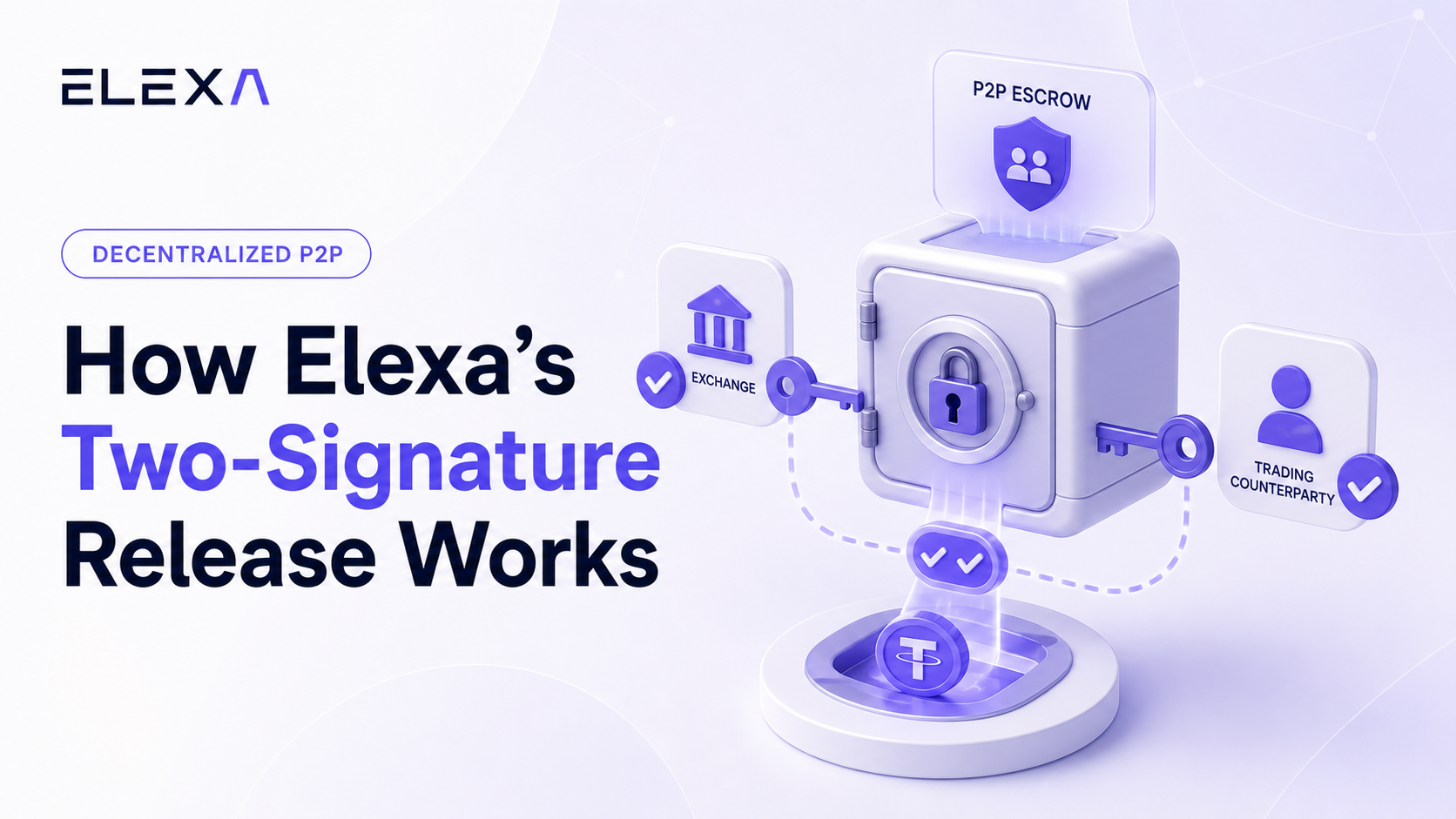
Answer first: Elexa’s decentralized P2P model does not allow one side to release funds alone. A release requires two signatures: one from the exchange side and one from the trading counterparty. If both required signatures are not provided, the funds are not released.
This shared-approval design is built around a simple idea: control over a P2P trade should not depend on one actor making a unilateral release decision. By requiring both approvals, Elexa adds a deliberate checkpoint between payment verification and fund release. The result is a clearer process for buyers, sellers, and exchanges that want more control over how a trade is completed.
This guide explains what two-signature release means, how the flow works, why it can reduce certain P2P trading risks, and what users should still verify before approving a transaction.
What is a two-signature release in P2P trading?
A two-signature release is a shared authorization rule. Instead of allowing a single party to move funds out of the trade, the release becomes available only after two required participants approve it.
In Elexa’s model, those participants are:
- The exchange side, which provides one required signature.
- The trading counterparty, which provides the second required signature.
Think of it like a vault with two keys. One key by itself cannot open the vault. Both keys must be used before the release condition is satisfied. The signatures are the approvals that tell the network the required participants agree the trade can move to the release stage.
The core rule: no complete pair of signatures, no fund release.
This is different from a single-party release flow, where one account or operator may be able to complete the release independently. Shared authorization reduces reliance on one decision-maker and creates a stronger separation between reviewing a trade and completing it.
How Elexa’s decentralized release flow works
The exact actions a buyer or seller takes depend on the offer and payment method, but the release logic follows a clear sequence.
1. A P2P trade is opened
The buyer and seller enter a trade using the selected offer, amount, price, payment method, and trade terms. Before sending payment, both sides should review the details inside Elexa and confirm that the names, limits, timing, and instructions match the agreement.
2. Funds enter the protected trade flow
The crypto allocated to the trade is placed into the trade’s release flow. At this point, the goal is to keep completion separate from any one participant’s unilateral action. Users should continue communicating and sharing evidence only through the platform so the trade record stays complete.
3. Payment and trade details are verified
The buyer follows the listed payment instructions. The receiving side verifies the payment through its own bank, wallet, mobile-money account, or other payment channel. A screenshot or message alone should not be treated as final proof. The payment should be independently confirmed in the actual receiving account.
4. Both required approvals are provided
Once the trade conditions have been checked, the exchange side signs and the trading counterparty signs. These two approvals work together. One signature alone is not enough to satisfy the release rule.
5. Funds can be released only after both signatures
When both required signatures are present, the release condition is met and the funds can move to the intended recipient. If either required signature is missing, the release does not occur. This is the central control behind Elexa’s two-signature model.
| Stage | Control | Why it matters |
|---|---|---|
| Trade opened | Offer and terms are visible | Both sides can review the same agreement |
| Funds committed | Release follows the trade process | Completion is separated from one-party action |
| Payment checked | Participants verify trade conditions | Approval can be based on evidence, not pressure |
| Two signatures provided | Shared authorization is complete | The release condition can be satisfied |
Why shared control can build more trust
It reduces single-party release risk
A single point of approval creates a single point of decision. Requiring two signatures makes unilateral release harder because neither required participant can complete the release alone. This does not remove every possible risk, but it changes the control structure in a meaningful way.
It encourages deliberate verification
The two-signature checkpoint gives participants a reason to pause and verify the payment, amount, account details, and trade status before approving. In P2P trading, that pause matters. Many avoidable mistakes happen when users rush, trust a screenshot, or respond to pressure outside the agreed process.
It makes responsibility clearer
Shared authorization shows that release is a coordinated action. Each required signer knows that an approval contributes directly to the final movement of funds. Clear responsibility can improve operational discipline for individual traders and exchange partners.
It supports a more decentralized P2P experience
Elexa’s design focuses on shared control rather than placing release power in the hands of one party. That approach fits the broader goal of non-custodial P2P trading: users participate directly in a trade while release follows a defined, jointly authorized process.
What happens if one party does not sign?
If the exchange side and the trading counterparty do not both provide their required signatures, the release condition remains incomplete and the funds are not released.
This prevents a partial approval from being treated as final authorization. It also means users should not assume that marking a payment as sent, sharing a receipt, or writing a message is the same as completing the release. The required approvals must still be provided through the defined Elexa flow.
If there is a disagreement, a payment problem, or a participant who will not approve, keep all records inside the platform and use Elexa’s available support or dispute process. Do not move the conversation to an unrecorded channel, cancel under pressure, or approve a release before independently confirming the facts.
What the two-signature model reduces—and what it does not
Two-signature release is a control mechanism, not a promise that every trade will be risk-free. It can reduce the risk of unilateral or premature release, but users still need to protect their accounts, verify payment, read offer terms, and watch for social-engineering attempts.
The model does not replace good P2P trading habits. It also should not be understood as a legal guarantee, a licensing claim, or a guarantee of 100% security. Market risk, payment reversals, account compromise, incorrect trade details, and user error can still matter.
For a broader operational checklist, read Elexa’s guide to common P2P trading mistakes and the practical guide on how to buy USDT safely.
A practical checklist before you sign
For buyers
- Confirm the offer amount, price, currency, and payment method before sending money.
- Pay only to the account listed in the active trade instructions.
- Use the payment reference requested by the offer, when applicable.
- Keep receipts and communication inside Elexa.
- Do not treat a message asking you to hurry as proof that the trade is ready.
- Review the final trade status before providing your approval.
For sellers and exchange partners
- Verify incoming payment in the actual receiving account.
- Check that the payer information and amount match the trade terms.
- Do not rely only on screenshots, emails, or SMS notifications.
- Confirm that any reversible or pending payment has genuinely settled according to the payment method.
- Do not provide a signature while material details remain unclear.
- Use the in-platform process when the evidence does not match.
Frequently asked questions
Can one party release the funds alone?
No. Elexa’s model requires both specified signatures. One required participant acting alone cannot satisfy the release condition.
Does “two signatures” mean two passwords?
No. The signatures are approvals used by the release mechanism. They are not the same as sharing account passwords, recovery phrases, or private login information. Never send sensitive credentials to another trader.
What if payment has been made but the second signature is missing?
The funds remain unreleased because the authorization pair is incomplete. Keep the payment evidence and conversation inside Elexa and follow the platform’s support or dispute steps rather than trying to finish the trade off-platform.
Does this make every P2P trade completely safe?
No system can remove all trading risk. Two-signature release reduces dependence on one release authority and adds shared control, but users must still verify payment, secure their accounts, follow trade terms, and respond carefully to suspicious behavior.
Why is this useful for decentralized P2P trading?
Decentralized P2P trading works best when participants have clear control and clear responsibilities. Requiring both approvals makes fund release a joint action and limits the ability of one required signer to complete it unilaterally.
The takeaway
Elexa’s two-signature release model is designed to make fund movement a shared decision. The exchange side and the trading counterparty must both sign; without both signatures, the funds are not released. That shared checkpoint can strengthen trust, reduce single-party risk, and make the release process easier to understand.
Good technology still depends on good trading practice. Review the offer, verify payment independently, keep evidence inside the platform, and approve only when the trade conditions are clear. You can explore available offers in the Elexa P2P market or learn more about Elexa’s approach to trust and transparency.
