

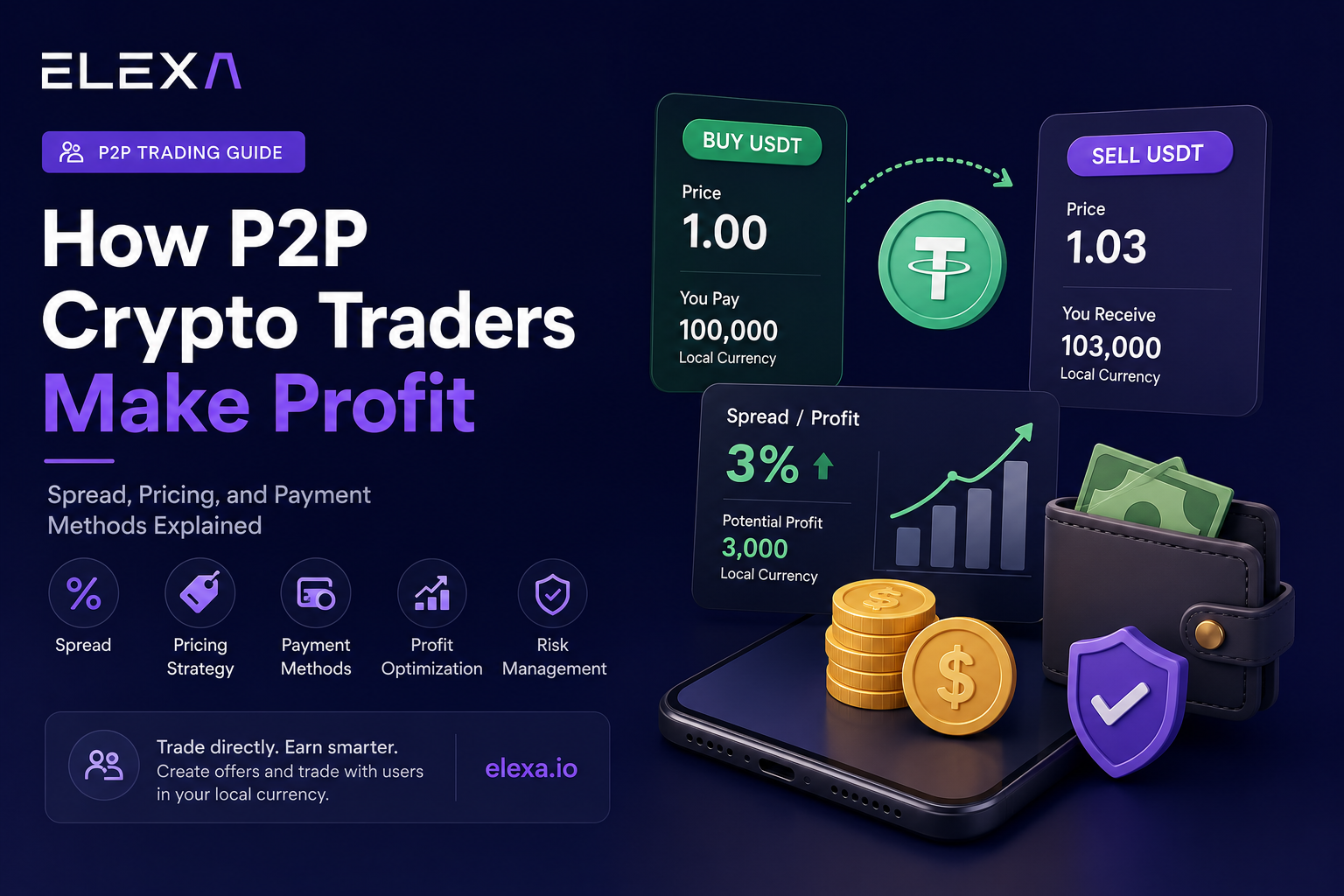
How P2P Crypto Traders Make Profit: Spread, Pricing, and Payment Methods Explained
Answer First
P2P crypto traders usually make profit by buying crypto at one price and selling it at a slightly higher price. This difference is called the spread.
In P2P trading, profit can come from several factors:
- Price difference between buy and sell offers
- Local currency demand
- Payment method availability
- Market liquidity
- Speed of payment confirmation
- Trade limits
- Country-specific supply and demand
- Seller reputation
- Ability to create clear and competitive offers
For example, a trader may buy USDT at a lower local rate and sell it later at a higher rate. The profit is not only about the crypto price itself. It also depends on how fast the trader can complete payments, which payment methods they support, how competitive their offer is, and how much trust they have built in the marketplace.
To make P2P trading work as a business, traders need to understand pricing, risk, payment methods, liquidity, and offer management.
Introduction
Many people start P2P crypto trading as buyers. They want to buy USDT, sell crypto for local currency, or use a payment method that works in their country.
But some users go one step further.
They become regular P2P traders or merchants.
Instead of only buying or selling when they need crypto, they create offers, manage prices, accept different payment methods, and try to earn profit from the spread between buy and sell prices.
This is why searches like “how to make money with P2P trading,” “P2P trading profit,” “how to become a P2P merchant,” and “USDT P2P arbitrage” are popular among crypto users.
P2P trading is not magic money. It is not passive income. It is closer to running a small trading operation.
A good P2P trader needs to understand:
- How pricing works
- How spreads are created
- Which payment methods attract users
- How local currency demand changes
- Why reputation matters
- How to manage trade limits
- How to avoid common mistakes
- How to create offers that buyers and sellers trust
This guide explains how P2P crypto traders make profit, how pricing works, and how payment methods affect earnings.
If you want to explore direct P2P crypto trading, you can visit Elexa and review how offers, payment methods, and local trading flows work.
What Is Profit in P2P Crypto Trading?
Profit in P2P trading usually comes from the difference between the price at which you buy crypto and the price at which you sell it.
This difference is called the spread.
For example:
Buy price: 1 USDT = 1.00 local currency unit
Sell price: 1 USDT = 1.03 local currency units

Spread: 3%
In simple terms, if you buy USDT at a lower rate and sell it at a higher rate, the difference can become your gross profit.
But that does not mean the full spread is your final profit.
You also need to consider:
- Payment provider fees
- Transfer costs
- Currency conversion costs
- Platform fees if any
- Failed or delayed payments
- Time spent managing trades
- Liquidity risk
- Price changes
- Operational mistakes
A smart P2P trader does not only look at the selling price. They calculate the real margin after all costs.
How the P2P Spread Works
The spread is the gap between buying and selling prices.
In P2P crypto trading, spreads are often created by local market conditions.
For example, USDT may be more expensive in one local market because many users want to buy it, but fewer sellers are available. In another market, the spread may be smaller because there are many active sellers competing with each other.
The spread can change based on:
- Country
- Local currency
- Payment method
- Available liquidity
- Time of day
- Market volatility
- Competition between sellers
- Buyer urgency
- Seller reputation
A high spread may look attractive, but it can also come with lower liquidity or higher payment risk.
A low spread may be safer and faster, but profit per trade is smaller.
The goal is not always to get the highest spread. The goal is to get a sustainable spread that works across many successful trades.
Example: Simple P2P USDT Profit Calculation
Imagine a trader buys 1,000 USDT at a local price of 100 per USDT.
Buy amount: 1,000 USDT
Buy price: 100
Total cost: 100,000 local currency
Later, the trader sells the same 1,000 USDT at 103 per USDT.
Sell amount: 1,000 USDT
Sell price: 103
Total received: 103,000 local currency
Gross profit:
103,000 - 100,000 = 3,000 local currency
Gross margin:
3,000 / 100,000 = 3%
But this is not the final profit yet.
If the trader pays 500 in transfer fees, conversion costs, or other charges, the net profit becomes:
3,000 - 500 = 2,500 local currency
Net margin:
2,500 / 100,000 = 2.5%
This is why serious P2P traders track every cost.
Main Ways P2P Traders Make Profit
1. Buy Low, Sell High
This is the most basic method.
A trader buys crypto at a lower price and sells it at a higher price.
In P2P markets, this may happen because different users have different needs. Some users want to buy quickly. Some sellers want to exit fast. Some payment methods have higher demand. Some countries have less liquidity.
The trader earns from the difference.
2. Payment Method Spread
Not all payment methods have the same value.
Some methods are faster. Some are more trusted. Some are harder to access. Some are more expensive. Some are popular in specific countries.
For example, a seller who accepts a high-demand local payment method may be able to offer a different price than a seller who only accepts slower or less convenient methods.
Payment methods can affect:
- Buyer demand
- Trade speed
- Risk level
- Verification process
- Trade limits
- Price competitiveness
This is why understanding P2P payment methods is very important for merchants.
3. Local Currency Demand
P2P trading is strongly connected to local currency markets.
In some countries, users want USDT because it is easier to move, store, or trade than local currency. In other countries, users want to sell USDT because they need local money for daily expenses.
This creates supply and demand.
A trader who understands local demand can price offers better.
For example:
- If many users want to buy USDT, sellers may have more pricing power.
- If many users want to sell USDT, buyers may find better rates.
- If payment options are limited, traders who support the right method may get more orders.
4. Faster Response and Better Availability
P2P trading is not only about price. Speed matters.
A buyer may choose a slightly more expensive seller if that seller responds quickly, has clear terms, and completes trades smoothly.
A seller who is online, responsive, and reliable can attract more trades.
This can create profit through volume.
A trader with smaller margins but higher completed trade volume may earn more than a trader with high margins but low activity.
5. Reputation and Trust
Reputation is one of the biggest assets in P2P trading.
Users often check:
- Number of completed trades
- Completion rate
- Feedback
- Profile age
- Verification level
- Dispute history if available
- Response time
- Offer clarity
A trusted trader can often compete better than a new or unclear trader.
This is why P2P profit is not only a pricing game. It is also a trust game.
6. Trade Limit Strategy
Trade limits can affect profitability.
Small trades may bring more users but require more time and more payment confirmations.
Large trades may create more profit per trade but may also require more trust, stronger payment methods, and better liquidity management.
A smart merchant chooses limits based on:
- Available balance
- Payment method limits
- Time availability
- Buyer demand
- Risk tolerance
- Local market behavior
For new traders, smaller limits are usually easier to manage.
7. Offer Management
P2P traders can improve results by creating better offers.
A good offer includes:
- Competitive price
- Clear payment method
- Simple instructions
- Realistic limits
- Fast response time
- Clear trade terms
- Reasonable payment time limit
If you want to create your own trading offer, read this guide on how to create a P2P offer.
You can also create your own offer directly on Elexa.
How Payment Methods Affect P2P Profit
Payment methods are one of the most important parts of P2P trading.
A trader who supports the right payment methods may get more orders and better pricing opportunities.
Different payment methods create different levels of convenience, speed, and risk.
Bank Transfer
Bank transfer is one of the most common payment methods in P2P trading.
It can be useful for larger trades because payment records are usually clear.
However, bank transfers may be slower in some countries or limited by banking hours, transfer limits, or local banking rules.
Mobile Money
Mobile money can be very powerful in markets where users rely on mobile wallets instead of traditional bank accounts.
For example, payment methods like M-Pesa can be useful in mobile-first markets where users want fast local transfers.
Digital Wallets
Digital wallets can make trades faster and easier for online users.
They may be useful for smaller or medium-sized trades, especially when users already keep balances in local wallet apps.
Local Payment Apps
Local payment apps are often very important because they match user habits in each country.
A payment method that is unpopular globally may still be extremely useful in one local market.
This is why P2P traders should understand their own country first.
Cash Deposit
Cash deposit may work in some markets, but it requires extra caution and clear proof.
Sellers should understand how to verify payment and whether the method fits their trading rules.
P2P Profit Is Not the Same as Arbitrage
Many people call P2P profit “arbitrage,” but not every P2P trade is true arbitrage.
Arbitrage usually means taking advantage of price differences between markets.
P2P trading may include arbitrage-like opportunities, but it also includes:
- Payment method management
- User communication
- Local currency handling
- Offer creation
- Liquidity planning
- Counterparty review
- Payment verification
So P2P profit is more operational than it looks.
A good P2P trader is part trader, part merchant, and part operations manager.
Common Costs That Reduce P2P Profit
Many beginners focus only on the spread and forget costs.
Here are common costs that can reduce profit:
Transfer Fees
Some payment methods charge fees for sending or receiving money.
Withdrawal Fees
If you move crypto between wallets or platforms, network or withdrawal fees may apply.
Currency Conversion Costs
If you convert between currencies, exchange rate differences may reduce profit.
Failed Trades
A failed trade can waste time and reduce available liquidity.
Delayed Payments
If payment takes too long, you may miss better opportunities.
Locked Liquidity
If your funds are stuck in pending trades, you cannot use them elsewhere.
Human Error
Wrong amounts, unclear terms, or poor record keeping can create losses.
Good P2P traders track these costs carefully.
How to Price a P2P Offer
Pricing is one of the most important skills for P2P merchants.
A good price should be competitive but profitable.
Before setting a price, check:
- Current market rate
- Competitor offers
- Local currency demand
- Payment method demand
- Your available liquidity
- Trade size
- Fees and costs
- Desired margin
- Your response speed
- Your reputation level
If you are new, avoid extreme prices.
A very high price may get no orders. A very low price may attract too many orders with weak profit.
Start with a realistic price, monitor activity, and adjust slowly.
How Beginners Can Start P2P Trading More Carefully
If you are new to P2P trading, do not start with large trades.
Start small and focus on learning the process.
Step 1: Study the Marketplace
Before creating an offer, look at existing offers.
Check:
- Prices
- Payment methods
- Trade limits
- Seller profiles
- Buyer behavior
- Popular local currencies
Step 2: Choose One Payment Method
Do not accept every payment method at the beginning.
Start with one method you understand well.
Step 3: Use Small Trade Limits
Small limits reduce pressure and help you learn.
Step 4: Write Clear Terms
Clear terms reduce confusion.
Example:
Payment must come from your own account.

Please send the exact amount shown in the trade.

Do not request off-platform communication.

After payment, follow the platform trade flow.
Step 5: Track Every Trade
Use a simple spreadsheet.
Track:
- Buy price
- Sell price
- Amount
- Payment method
- Fees
- Net profit
- Time spent
- Trade result
Step 6: Improve Slowly
Once you understand the flow, you can adjust limits, prices, and payment methods.
Common Mistakes That Reduce P2P Profit
Mistake 1: Looking Only at Spread
A high spread does not always mean high profit. Costs, delays, and failed trades matter.
Mistake 2: Accepting Too Many Payment Methods
More methods can bring more users, but they also create more complexity.
Mistake 3: Setting Unclear Terms
Unclear offer terms can lead to disputes and slow trades.
Mistake 4: Using Large Limits Too Early
Large trades require more experience and stronger verification.
Mistake 5: Ignoring Reputation
A strong profile can be more valuable than a slightly better price.
Mistake 6: Not Tracking Costs
If you do not track costs, you may think you are profitable when you are not.
Mistake 7: Moving Trades Outside the Platform
Off-platform trades are harder to review and can create unnecessary problems.
For more details, read our guide on common P2P trading mistakes.
How to Build a Strong P2P Merchant Profile
If you want to trade regularly, your profile matters.
To build trust:
- Respond quickly
- Complete trades professionally
- Keep clear terms
- Use reliable payment methods
- Avoid unnecessary cancellations
- Keep communication inside the platform
- Start with realistic trade limits
- Maintain consistent availability
- Be polite and clear
- Track your performance
Over time, a strong profile can help you attract more users.
This is why serious traders do not treat each trade separately. They build a long-term trading reputation.
Is P2P Trading Profit Guaranteed?
No.
P2P trading can create profit opportunities, but profit is never guaranteed.
Your result depends on:
- Market conditions
- Competition
- Local demand
- Payment method quality
- Trade volume
- Costs
- User behavior
- Platform rules
- Your own discipline
P2P trading should be treated carefully.
Do not trade with money you cannot afford to lose. Do not take large trades before you understand the process. Do not trust high spreads without checking the risks and costs.
A practical P2P trader focuses on consistency, not hype.
Why Elexa Matters for P2P Traders
A good P2P marketplace should help users compare offers, choose payment methods, understand trade terms, and trade directly with other users.
Elexa is built for P2P crypto trading with local payment methods, user-created offers, and direct buyer-seller interaction.
For traders who want more control, the ability to create offers is important.
Instead of only accepting existing prices, sellers and merchants can define:
- Price
- Local currency
- Payment method
- Trade limits
- Offer terms
- Availability
You can start by exploring the marketplace on Elexa or create your own trading offer through the Create Offer page.
FAQ
How do P2P crypto traders make money?
P2P traders usually make money from the spread between buy and sell prices. They may also benefit from local currency demand, payment method availability, and strong offer management.
What is spread in P2P trading?
Spread is the difference between the price at which a trader buys crypto and the price at which they sell it.
Can I make money with P2P USDT trading?
It is possible, but profit is not guaranteed. You need to understand pricing, payment methods, costs, liquidity, and trade risk.
What is a P2P merchant?
A P2P merchant is a trader who regularly creates buy or sell offers and provides liquidity to other users in a marketplace.
Which crypto is popular for P2P trading?
USDT is commonly used in P2P trading because many users understand it and it is widely supported across crypto marketplaces.
Which payment method is best for P2P profit?
There is no single best method. The best payment method depends on your country, user demand, speed, verification process, and fees.
Is P2P trading the same as arbitrage?
Not exactly. P2P trading may include arbitrage-like opportunities, but it also requires payment management, communication, pricing, and operational discipline.
How should beginners start P2P trading?
Beginners should start with small trades, one payment method, clear terms, and careful tracking of costs and results.
How do I create a P2P offer?
You can create a P2P offer by choosing the crypto asset, local currency, price, payment method, trade limits, and offer terms.
Where can I create a P2P offer?
You can create a P2P offer on Elexa and define your own price, payment methods, and trade limits.
Conclusion
P2P crypto trading can create profit opportunities, but it is not just about buying low and selling high.
Successful P2P traders understand spread, pricing, local currency demand, payment methods, liquidity, costs, and reputation.
The best traders do not chase every trade. They create clear offers, choose payment methods carefully, track costs, and build trust over time.
If you are new, start small. Learn how payment confirmation works. Understand your local market. Track every trade. Improve your offer step by step.
P2P trading is a marketplace skill.
The more you understand pricing, payment methods, and user behavior, the better your decisions become.
Soft CTA
Explore Elexa to compare P2P crypto offers, payment methods, and local trading options.
If you want to set your own price and trade limits, you can Create an Offer and start building your P2P trading profile.
