

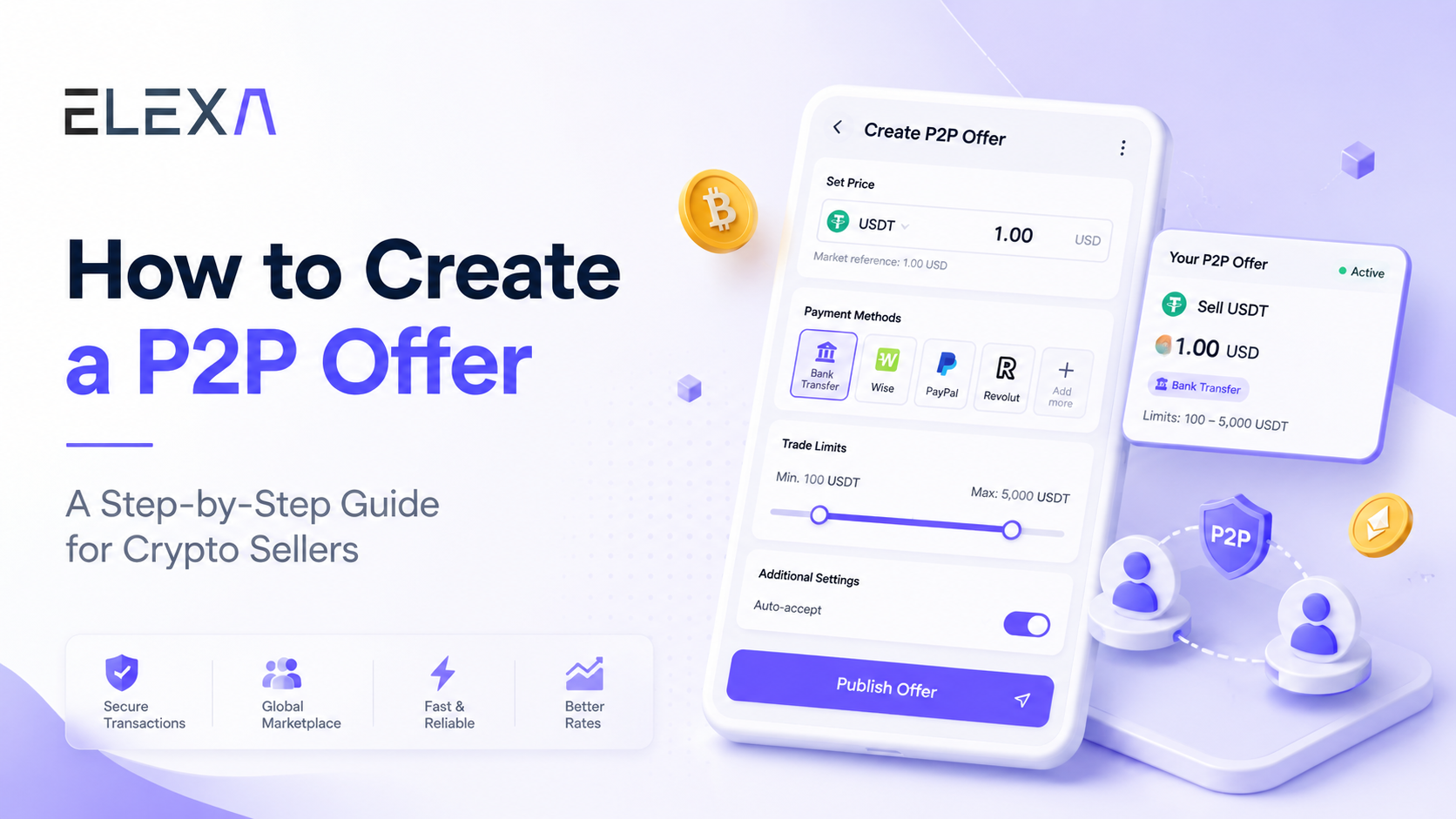
How to Create a P2P Offer: A Step-by-Step Guide for Crypto Sellers
Answer First
A P2P offer is a public listing that allows other users to buy or sell crypto directly with you. When you create a P2P offer, you define the crypto asset, price, trade limits, payment methods, trade terms, and conditions that other users must follow.
To create a strong P2P offer, you should:
- Choose the crypto asset you want to buy or sell
- Set a clear and competitive price
- Define minimum and maximum trade limits
- Select payment methods you can verify easily
- Write simple trade instructions
- Set realistic response and completion times
- Explain important rules clearly
- Build trust through profile quality and trading history
- Start with smaller limits if you are new
- Update your offer based on market demand
A good P2P offer is not just about price. It should be clear, trustworthy, easy to understand, and safe for both sides of the trade.
Introduction
P2P crypto trading is built around offers.
An offer is the bridge between a buyer and a seller. It tells other users what you want to trade, how much you are willing to trade, which payment methods you accept, what price you are offering, and what conditions must be followed.
For buyers, offers make it easier to compare sellers and choose the right trade. For sellers and merchants, offers are a way to attract demand, build reputation, and trade on their own terms.
This is one of the main advantages of P2P marketplaces. Instead of waiting for a fixed exchange flow, users can create their own terms and trade directly with others.
But creating a good offer requires more than entering a price.
A weak offer can confuse buyers, create disputes, attract the wrong counterparties, or make you look unreliable. A strong offer can increase trust, improve completion rates, and help you build a better trading profile.
This guide explains how to create a P2P offer step by step, what details to include, what mistakes to avoid, and how to make your offer more attractive to serious traders.
What Is a P2P Offer?
A P2P offer is a trading listing created by a user or merchant on a peer-to-peer crypto marketplace.
It usually includes:
- The crypto asset being bought or sold
- The fiat or local currency used
- The price or exchange rate
- Minimum and maximum trade limits
- Payment methods
- Trade instructions
- Time limits
- Buyer or seller requirements
- Additional terms
For example, a seller may create an offer to sell crypto and receive payment through bank transfer, mobile money, digital wallet, or another supported method.
A buyer can then review that offer, check the seller’s profile, read the terms, and decide whether to start a trade.
Platforms such as Elexa are built around user-created offers, allowing buyers and sellers to trade directly through a structured P2P marketplace.
Why P2P Offers Matter
P2P offers are important because they create liquidity.
Liquidity means there are enough active buyers and sellers for trades to happen smoothly. If a marketplace has few offers, users may visit the platform and leave because they cannot find a suitable trade. If there are many clear and competitive offers, users are more likely to start trading.
For sellers and merchants, offers are also a way to build visibility.
A strong offer can help you:
- Attract more buyers
- Build trading history
- Improve your reputation
- Choose your preferred payment methods
- Set your own price
- Control trade limits
- Avoid unclear or risky trades
- Trade more consistently
For buyers, offers make it easier to compare options and choose the counterparty that best fits their needs.
Benefits of Creating a P2P Offer
Creating your own P2P offer gives you more control over how you trade.
1. You Set Your Own Price
When you create an offer, you can choose your preferred price or rate. You can make your offer competitive, adjust it based on market conditions, or price in the cost of payment method risk, speed, and availability.
2. You Choose Payment Methods
Not every payment method works for every trader. As an offer creator, you can choose the methods you understand and can verify properly.
This is especially useful for sellers, because some payment methods are easier to confirm than others.
3. You Define Trade Limits
You can set minimum and maximum amounts for each trade. This helps you avoid trades that are too small to be worth your time or too large for your current risk level.
4. You Write Your Own Terms
Offer terms help prevent confusion. You can explain what users should do, which payment details matter, what evidence is required, and what actions are not allowed.
5. You Build a Merchant Profile
If you create offers consistently and complete trades professionally, you can build a stronger profile. Over time, buyers may prefer your offers because they can see your history, response behavior, and reliability.
6. You Serve Local Demand
Many users want to buy or sell crypto using payment methods available in their country. By creating offers that match local payment behavior, you can serve real market demand.
Risks of Creating a P2P Offer
Creating offers can be useful, but it also comes with responsibility.
Payment Risk
Some payment methods may be reversible, delayed, or difficult to verify. If you accept a method you do not understand, you may expose yourself to disputes or fraud.
Fake Payment Receipts
Sellers should be careful with screenshots or edited receipts. Payment should be verified directly through the official payment account, not only through images sent by the buyer.
Third-Party Payments
A buyer may send payment from someone else’s account. This can create fraud, ownership, and dispute risks.
Unclear Terms
If your offer terms are vague, buyers may misunderstand the process. This can lead to failed trades or disputes.
Slow Response Time
If you create an offer but do not respond quickly, your completion rate and reputation may suffer.
Price Volatility
If your offer price does not update with market movement, you may trade at an unfavorable rate.
Step-by-Step Guide: How to Create a P2P Offer
Step 1: Choose Whether You Want to Buy or Sell
The first step is deciding your offer type.
You may create an offer to:
- Sell crypto for fiat or local currency
- Buy crypto using a selected payment method
Most beginner merchants start by selling crypto, because buyers often search for available sell offers when they want to purchase crypto directly.
Before choosing, ask yourself:
- Do I have crypto available to sell?
- Do I want to receive local currency?
- Do I understand the payment method?
- Can I respond quickly to buyers?
- Am I ready to handle trade instructions and evidence?
If you are new, start with small trade limits until you understand the full flow.
Step 2: Choose the Crypto Asset
Choose the crypto asset you want to trade.
Common P2P assets may include stablecoins and major cryptocurrencies, depending on the marketplace. Stablecoins are often popular because their price is easier to understand compared with highly volatile assets.
When choosing an asset, consider:
- Demand in your target market
- Price stability
- Network fees
- Transfer speed
- User familiarity
- Liquidity
If users in your market mostly search for stablecoins, your stablecoin offers may attract more demand. If users prefer BTC, ETH, or another asset, your offer strategy may be different.
Step 3: Select the Fiat Currency or Local Currency
Next, choose the currency you want to receive or pay.
This may be a local currency or another supported fiat currency. Your currency choice should match your payment methods and target users.
For example, if your offer is aimed at users in a specific country, choose the currency they actually use for payments.
A mismatch between currency and payment method can confuse users and reduce trust.
Step 4: Choose Payment Methods
Payment method selection is one of the most important parts of a P2P offer.
You should choose payment methods that are:
- Available to your target users
- Easy for you to verify
- Suitable for your trade size
- Clear in transaction records
- Not too risky for reversals or disputes
- Consistent with your offer terms
Common payment methods include:
- Bank transfers
- Mobile money
- Digital wallets
- Local payment apps
- Cash deposits
- Regional payment systems
If you are a seller, prioritize payment methods that allow you to confirm payment directly and clearly.
Do not accept payment methods only because they are popular. Accept them because you understand how they work.
Step 5: Set Your Price
Your price is one of the first things users notice.
A competitive price can attract more buyers, but the cheapest price is not always the best strategy. If your price is too low, you may reduce your margin or attract low-quality trades. If your price is too high, users may ignore your offer.
When setting price, consider:
- Current market price
- Platform competition
- Payment method risk
- Payment method fees
- Speed of settlement
- Your desired margin
- Local demand
- Trade size
For example, a payment method with higher reversal risk may require a different price than a safer, more final payment method.
Good pricing is realistic, not random.
Step 6: Set Minimum and Maximum Trade Limits
Trade limits define how much users can trade with you in a single order.
Minimum limit helps you avoid very small trades that are not worth the time or payment fees.
Maximum limit helps you control risk.
For beginners, smaller maximum limits are safer. For experienced merchants, higher limits may attract more serious buyers.
A good starting strategy is:
- Use smaller limits while building history
- Increase limits after successful trades
- Set different offers for different trade sizes
- Avoid accepting large trades from unknown users too early
Your trade limits should match your available balance, payment method capacity, and risk tolerance.
Step 7: Set a Realistic Payment Time Limit
The payment time limit tells the buyer how long they have to complete payment.
If the time limit is too short, buyers may fail to complete payment. If it is too long, your funds or attention may be tied up unnecessarily.
A good payment time depends on the method.
For example:
- Fast local apps may need shorter time limits
- Bank transfers may need more time
- Cash deposits may need longer windows
- Regional systems may depend on business hours
Set a time limit that gives serious buyers enough time but discourages inactive trades.
Step 8: Write Clear Offer Terms
Offer terms are where many P2P trades succeed or fail.
Clear terms reduce confusion and disputes.
Your terms should explain:
- Which payment method is accepted
- Whether third-party payments are allowed
- Whether account name must match
- What payment reference should be used
- What proof of payment is required
- What the buyer should not do
- What happens if payment is delayed
- Whether payment notes are allowed
- How quickly you usually respond
Avoid long, aggressive, or confusing terms. Users should understand your rules quickly.
Example Offer Terms
Please pay only through the selected payment method.

The payment account name must match your platform profile. Third-party payments are not accepted.

After payment, mark the trade as paid and upload clear payment proof.

Do not ask to continue the trade outside the platform.
Simple terms are often better than complicated terms.
Step 9: Add Safety Instructions
Safety instructions help protect both sides.
For sellers, important instructions may include:
- Do not send payment from another person’s account
- Do not use a different payment method
- Do not mark paid before sending payment
- Keep payment proof
- Stay inside the platform chat
For buyers, good seller instructions create confidence because they show that the offer creator is serious and organized.
You can also add a friendly note:
If you are new to P2P trading, please read the terms carefully before starting the trade.
Step 10: Review Your Offer Before Publishing
Before publishing, review everything carefully.
Check:
- Asset
- Currency
- Price
- Payment method
- Minimum limit
- Maximum limit
- Time limit
- Terms
- Account details
- Risk level
- Availability
A small mistake in payment details or pricing can create real problems.
Do not publish an offer until you are ready to respond to trades.
Step 11: Stay Available After Publishing
Once your offer is live, users may start trades with you.
If you do not respond quickly, your reputation may suffer. P2P marketplaces often reward active and reliable users.
Good offer creators:
- Stay online when offers are active
- Respond quickly
- Follow the platform flow
- Confirm payment carefully
- Keep communication professional
- Avoid unnecessary delays
- Pause offers when unavailable
If you are busy or offline, consider temporarily disabling your offer.
Step 12: Improve Your Offer Over Time
A good P2P offer is not static.
You should update it based on:
- Market price changes
- Buyer behavior
- Payment method demand
- Completion rate
- Dispute history
- User feedback
- Competitor offers
- Local market activity
If buyers keep asking the same question, your terms may need improvement.
If your offer gets views but few trades, your price, limits, or payment method may need adjustment.
If you get too many small trades, raise your minimum limit.
If you get no trades, your offer may not match market demand.
How to Make Your P2P Offer More Attractive
Build a Complete Profile
Users are more likely to trade with profiles that look real and reliable.
A strong profile may include:
- Verified account details
- Clear trading history
- Positive feedback
- Fast response behavior
- Reasonable completion rate
- Clear payment methods
- Professional communication
Use Clear Pricing
Avoid confusing or unrealistic pricing. Users should immediately understand the rate.
Choose Popular Payment Methods
Payment methods affect demand. If you choose methods that users in your market already use, your offer may perform better.
Keep Terms Simple
Long terms can scare users away. Clear terms build confidence.
Start With Smaller Limits
If you are new, smaller limits help you build a record safely.
Respond Quickly
Fast response is one of the strongest trust signals in P2P trading.
Common Mistakes When Creating a P2P Offer
Mistake 1: Setting an Unrealistic Price
A price that is too high may get ignored. A price that is too low may create risk or reduce profit. Set a price that fits the market.
Mistake 2: Accepting Too Many Payment Methods
More payment methods are not always better. Only accept methods you can verify properly.
Mistake 3: Writing Confusing Terms
If buyers do not understand your terms, disputes become more likely.
Mistake 4: Setting Limits Too High
New merchants should avoid large trades before building reputation.
Mistake 5: Going Offline With Active Offers
If your offer is active, users expect you to respond. Disable your offer when you are unavailable.
Mistake 6: Accepting Third-Party Payments Without Rules
Third-party payments can create fraud and dispute risk. Be clear about whether they are allowed.
Mistake 7: Trusting Screenshots Too Quickly
Sellers should verify payment directly, not only through screenshots.
Mistake 8: Not Updating the Offer
Markets change. If your offer is outdated, it may become uncompetitive or risky.
How Buyers Evaluate Your Offer
Buyers usually look at several factors before starting a trade.
They may check:
- Price
- Payment method
- Minimum and maximum limits
- Seller profile
- Verification level
- Completed trades
- Feedback
- Response time
- Offer terms
- Recent activity
Your offer should make buyers feel that the trade is clear and manageable.
If the offer looks confusing, users may choose another seller.
P2P Offer Checklist
Before publishing your offer, ask:
- Is my price realistic?
- Are my payment methods easy to verify?
- Are my trade limits safe?
- Are my terms clear?
- Am I available to respond?
- Do I understand the payment risks?
- Can I handle disputes if needed?
- Is my profile trustworthy?
- Did I review all details before publishing?
If the answer is yes, your offer is ready to go live.
FAQ
What is a P2P offer?
A P2P offer is a listing created by a user who wants to buy or sell crypto directly with another user. It includes price, payment methods, limits, and trade terms.
Who can create a P2P offer?
This depends on the marketplace. Some platforms allow all verified users to create offers, while others require merchant approval or additional checks.
What should I include in my offer terms?
Include accepted payment methods, account name rules, proof of payment requirements, payment time limits, and any restrictions such as no third-party payments.
What is the best payment method for a P2P offer?
The best payment method depends on your country, risk tolerance, and trade size. Choose methods you can verify clearly and use confidently.
Should I create one offer or multiple offers?
If you accept different payment methods or trade sizes, multiple offers may be useful. Each offer should have clear terms.
How do I price my P2P offer?
Check market rates, competitor offers, payment method risk, fees, and your desired margin before setting a price.
Should beginners set high trade limits?
No. Beginners should start with smaller limits and increase them after building successful trade history.
Can I change my offer after publishing?
Most P2P marketplaces allow users to update offers. You should review and update your offer regularly.
Why is my offer not getting trades?
Possible reasons include uncompetitive pricing, unpopular payment methods, unclear terms, low profile trust, or trade limits that do not match user demand.
How can I make my offer safer?
Use clear terms, accept payment methods you understand, avoid third-party payments unless allowed, verify payments carefully, and keep communication inside the platform.
Conclusion
Creating a P2P offer is one of the most important ways to participate in a peer-to-peer crypto marketplace.
A strong offer helps buyers understand what you are offering, how the trade works, which payment methods are accepted, and what rules must be followed.
The best P2P offers are clear, realistic, and trustworthy. They use payment methods the creator understands, set safe trade limits, explain terms simply, and match real market demand.
For sellers and merchants, offers are also a way to build reputation. Every completed trade, fast response, and clear instruction can help strengthen your profile.
If you are new to creating offers, start small. Choose one or two payment methods you understand well. Set realistic limits. Write simple terms. Respond quickly. Improve your offer over time.
A good P2P offer does not just attract trades. It builds trust.
Soft CTA
If you want to buy or sell crypto directly with your own terms, you can explore available offers on Elexa.
When you are ready to set your own price, limits, and payment methods, you can Create an Offer and start building your P2P trading profile.
