

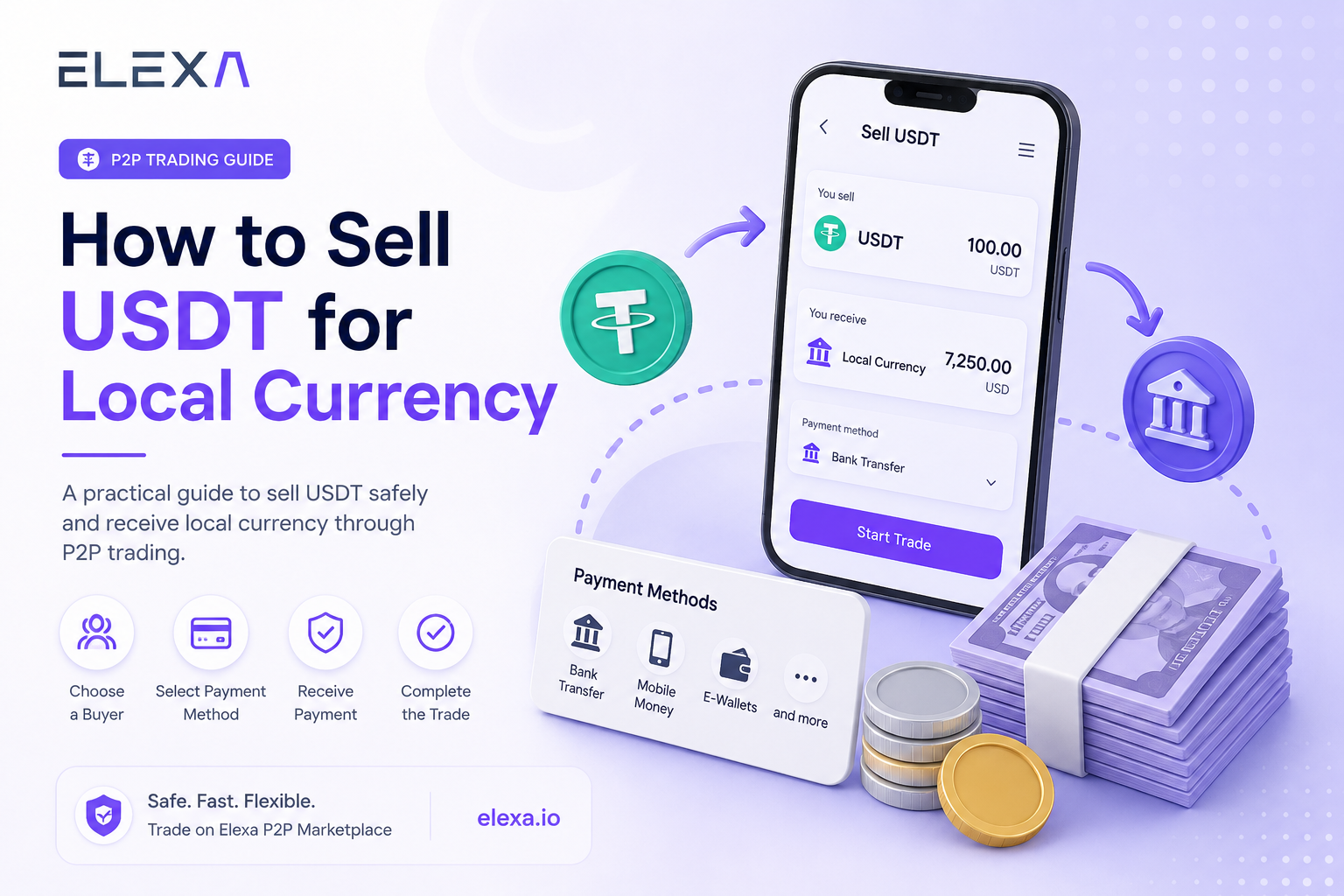
How to Sell USDT for Local Currency: A Practical Guide for P2P Crypto Traders
Answer First
The easiest way to sell USDT for local currency is through a P2P crypto marketplace where you can choose a buyer, select a payment method, follow the trade instructions, and receive payment directly in your preferred currency.
Selling USDT through P2P trading is useful because it gives you more control over payment methods, pricing, trade limits, and who you trade with. Instead of relying on a single exchange withdrawal method, you can choose from multiple payment options based on what is available in your country.
To sell USDT for local currency safely and smoothly, you should:
- Choose a reliable P2P marketplace
- Review buyer profiles before trading
- Select payment methods you can verify clearly
- Set realistic trade limits
- Check payment confirmation carefully
- Keep records of the trade
- Avoid off-platform deals
- Use clear offer terms if you create your own offer
- Start with smaller trades if you are new
Selling USDT is not only about getting the best rate. It is about choosing the right buyer, the right payment method, and the right process.
Introduction
USDT is one of the most widely used cryptocurrencies in peer-to-peer trading. Many people use it because it is stable, easy to understand, and commonly accepted across crypto platforms.
For many users, buying USDT is only one side of the process. At some point, they also need to sell USDT and receive local currency.
This may happen for different reasons. A freelancer may receive USDT and want to convert it into local money. A trader may want to cash out profits. A merchant may need liquidity. A user may want to pay local expenses. Someone else may simply want to move from crypto back into their everyday currency.
This is where P2P trading becomes useful.
A P2P marketplace allows users to sell USDT directly to other users using different payment methods. Instead of waiting for one fixed withdrawal option, sellers can choose how they want to receive money.
Depending on the marketplace and country, sellers may receive local currency through bank transfer, mobile money, digital wallets, local payment apps, cash deposit, or other supported methods.
This guide explains how to sell USDT for local currency, what to check before accepting a trade, which payment methods matter, how to create a strong sell offer, and how to avoid common mistakes.
What Does It Mean to Sell USDT for Local Currency?
Selling USDT for local currency means exchanging your USDT for fiat money used in a specific country or region.
For example:
- Selling USDT for Turkish lira
- Selling USDT for Nigerian naira
- Selling USDT for Pakistani rupee
- Selling USDT for Philippine peso
- Selling USDT for Kenyan shilling
- Selling USDT for Ghanaian cedi
- Selling USDT for any supported local currency
In a P2P trade, you usually sell USDT to another user who wants to buy it. The buyer pays you using the agreed payment method. Once the payment is confirmed according to the platform process, the trade is completed.
This model is useful because it connects crypto liquidity with local payment systems.
Why People Sell USDT Through P2P Trading
Many users choose P2P trading because it gives them flexibility that may not be available through traditional exchange withdrawals.
1. Access to Local Payment Methods
One of the biggest benefits is the ability to receive money through payment methods available in your country.
Depending on the marketplace, this may include:
- Bank transfers
- Mobile money
- Digital wallets
- Local payment apps
- Cash deposit
- Regional payment systems
- Other supported payment methods
This is especially useful in markets where direct exchange withdrawals are limited, slow, expensive, or unavailable.
2. More Control Over Price
When selling USDT through P2P, you may be able to compare buyer offers or create your own sell offer. This gives you more control over the rate you accept.
Some sellers prefer quick trades at competitive rates. Others create offers with specific payment methods and trade limits.
3. Flexible Trade Limits
P2P trading allows sellers to define minimum and maximum trade amounts. This is helpful because not every seller wants to process very small trades or very large trades.
For example, a seller may decide to sell between 50 and 500 USDT per trade, while a more experienced merchant may accept higher limits.
4. Useful for Freelancers and Remote Workers
Many freelancers, remote workers, and online service providers receive payments in USDT. P2P trading can help them convert USDT into their local currency when they need to spend money locally.
5. Better Fit for Emerging Markets
In many emerging markets, local payment behavior is different from global banking systems. P2P trading helps users sell crypto using the payment methods people actually use in their country.
How P2P Selling Works
The exact flow depends on the platform, but most P2P USDT selling follows a similar structure.
Step 1: Choose a Marketplace
Start by choosing a P2P marketplace with clear trading rules, buyer and seller profiles, multiple payment methods, and a structured trade flow.
A platform like Elexa is built around direct P2P crypto trading, user-created offers, and multiple payment methods.
Step 2: Select USDT
Choose USDT as the asset you want to sell.
Make sure you understand which network or wallet system is supported by the platform before depositing or trading.
Step 3: Choose Local Currency
Select the currency you want to receive.
This should match the payment method and country where you want to receive funds.
Step 4: Find a Buyer or Create an Offer
You can either accept an existing buy offer or create your own sell offer.
If you accept an existing offer, review the buyer’s profile and terms carefully.
If you create your own offer, you choose the price, payment method, trade limits, and instructions.
Step 5: Confirm the Payment Method
Before starting or accepting a trade, make sure the payment method is one you can verify clearly.
Sellers should choose payment methods they understand well.
Step 6: Complete the Trade
Follow the platform flow. Keep communication inside the platform, verify payment carefully, and complete the trade only when the required conditions are met.
Best Payment Methods for Selling USDT
The best payment method depends on your country, buyer availability, trade size, and risk tolerance.
For a deeper breakdown, you can read our guide on Best Payment Methods for P2P Trading.
Here are the most common options.
Bank Transfer
Bank transfer is one of the most common ways to receive local currency.
It is often useful because transaction records are clear, sender details may be visible, and larger amounts may be supported.
Sellers should confirm that the payment has actually arrived in their own bank account before completing the trade.
Mobile Money
Mobile money is popular in many emerging markets. It can be fast, accessible, and widely used by people who may not rely on traditional bank accounts.
Sellers should understand how payment confirmation works inside the mobile money app.
Digital Wallets
Digital wallets can be useful for online traders, freelancers, and users who already use wallet-based payment systems.
They may be fast and convenient, but sellers should understand the wallet’s transaction history, sender details, and confirmation rules.
Local Payment Apps
Many countries have payment apps that are used for everyday transfers. These apps may be bank-linked, wallet-based, QR-based, or mobile-number-based.
They can be very effective when both buyer and seller understand them clearly.
Cash Deposit
Cash deposit may be used in some markets, but sellers should be careful and make sure the payment can be verified properly.
Cash-related methods often require clearer terms and stronger evidence.
How to Choose the Right Buyer
Selling USDT means you are receiving local currency from another user. That makes buyer quality important.
Before accepting a trade, check the buyer’s profile.
Look for:
- Completed trades
- Positive feedback
- Reasonable activity history
- Clear payment behavior
- Profile verification level
- Low dispute history if available
- Consistent account details
- Professional communication
A buyer with a slightly worse rate but stronger profile may be better than a buyer offering a very attractive price with little history.
Price matters, but profile quality matters too.
How to Set a Good Price When Selling USDT
If you create your own offer, pricing is important.
A good price should be competitive, realistic, and aligned with market demand.
When setting your price, consider:
- Current USDT market price
- Local currency demand
- Payment method speed
- Payment method risk
- Platform competition
- Trade size
- Your desired margin
- Local liquidity
If your price is too high, buyers may ignore your offer. If it is too low, you may lose margin or attract low-quality trades.
Many sellers adjust prices based on payment method. For example, a fast and reliable payment method may support a different rate than a slower or more complicated one.
How to Create a Sell Offer
Creating your own sell offer gives you more control.
A strong offer should include:
- Crypto asset: USDT
- Local currency
- Price
- Minimum trade amount
- Maximum trade amount
- Accepted payment methods
- Payment time limit
- Clear trade terms
- Buyer requirements
- Proof of payment expectations
If you want a full step-by-step breakdown, read our guide on How to Create a P2P Offer.
Example Sell Offer Terms
Please use only the selected payment method.

Payment must come from an account in your own name. Third-party payments are not accepted.

After payment, mark the trade as paid and upload clear payment proof.

Do not ask to continue the trade outside the platform.
Clear terms help buyers understand what to do and reduce confusion during the trade.
Trade Limits: How Much USDT Should You Sell?
Trade limits are important for managing your activity.
If you are new to selling USDT, start with smaller limits. This helps you understand the process without taking on too much complexity at once.
For example, a beginner seller might start with:
- Minimum: 20 USDT
- Maximum: 200 USDT
An experienced seller or merchant may use higher limits once they have more confidence, better payment method experience, and stronger profile history.
Trade limits should match:
- Your available USDT balance
- Payment method limits
- Your risk tolerance
- Buyer demand
- Your response availability
- Platform rules
Do not set limits higher than you can comfortably manage.
Seller Checklist Before Completing a Trade
Before completing the crypto side of a trade, sellers should check everything carefully.
Ask yourself:
- Has the buyer paid using the selected payment method?
- Did the payment arrive in my own account?
- Is the amount exact?
- Does the sender name match the expected buyer?
- Is the payment final, not pending?
- Did the buyer follow the offer terms?
- Is all communication inside the platform?
- Do I have evidence if support needs to review the trade?
Sellers should be patient and careful. A smooth trade is better than a rushed trade.
Common Mistakes When Selling USDT
Selling USDT through P2P is simple when you follow the process, but mistakes can still happen.
Mistake 1: Choosing Buyers Only by Price
A better rate is attractive, but buyer profile quality matters.
Mistake 2: Accepting Payment Methods You Do Not Understand
Sellers should only accept methods they can verify clearly.
Mistake 3: Writing Unclear Offer Terms
Unclear terms create confusion and disputes. Keep instructions simple.
Mistake 4: Going Offline With Active Offers
If your offer is active, buyers expect you to respond. Pause your offer when unavailable.
Mistake 5: Not Keeping Records
Keep payment confirmations, chat history, and trade details until the trade is fully completed.
Mistake 6: Moving Outside the Platform
Off-platform communication can make trades harder to review. Keep the important parts inside the platform.
You can also read our guide on Common P2P Trading Mistakes to avoid the most common errors made by buyers and sellers.
How to Build Trust as a USDT Seller
Trust is one of the most important parts of P2P trading.
If buyers trust your offer, they are more likely to trade with you.
To build trust:
- Complete trades professionally
- Respond quickly
- Use clear terms
- Keep your payment details accurate
- Avoid unnecessary cancellations
- Choose payment methods you understand
- Maintain a strong completion rate
- Keep communication polite and direct
- Update your offer when needed
Over time, your trading profile becomes one of your strongest assets.
A good seller does not only offer a good rate. A good seller offers clarity, reliability, and consistency.
Why Local Currency Matters in P2P Trading
Local currency support is one of the biggest advantages of P2P trading.
Many users do not want to move through complicated global payment systems. They simply want to convert USDT into money they can use in daily life.
P2P trading can help connect USDT with local payment systems, making crypto more practical for everyday users.
This is especially useful for:
- Freelancers
- Remote workers
- Local merchants
- Crypto traders
- Users receiving international payments
- People in markets with limited exchange withdrawals
Selling USDT for local currency makes crypto more usable.
Should You Sell USDT Through P2P or a Centralized Exchange?
Both options can work, but they serve different needs.
A centralized exchange may be suitable if it supports your country, currency, and withdrawal method.
P2P may be more useful if:
- Your local currency is not directly supported
- You want more payment options
- You want to choose your buyer
- You want to set your own offer terms
- You need local payment methods
- You want flexible trade limits
P2P trading gives users more control over the local cash-out process.
FAQ
Can I sell USDT for local currency?
Yes. P2P marketplaces allow users to sell USDT directly to buyers and receive payment in local currency through supported payment methods.
What is the best way to sell USDT?
The best way depends on your country, payment method, trade size, and buyer profile. Many users prefer P2P trading because it offers flexible local payment options.
Which payment method is best for selling USDT?
Bank transfer, mobile money, digital wallets, and local payment apps are common options. The best method is one you can verify clearly and use confidently.
Should I create my own USDT sell offer?
If you want more control over price, limits, and payment methods, creating your own offer can be useful.
How do I choose a buyer?
Check the buyer’s profile, trade history, feedback, payment method, and communication behavior before accepting a trade.
Can I sell small amounts of USDT?
Yes. Many P2P marketplaces allow sellers to set minimum and maximum trade limits.
Why are offer terms important?
Offer terms explain how the trade should happen. Clear terms reduce confusion and help both sides follow the correct process.
Is P2P selling good for freelancers?
Yes. Freelancers who receive USDT may use P2P trading to convert it into local currency through available payment methods.
Can I sell USDT with multiple payment methods?
Yes, depending on the marketplace. Some sellers create separate offers for different payment methods.
How can I improve my seller profile?
Complete trades professionally, respond quickly, write clear terms, choose reliable payment methods, and maintain a strong completion rate.
Conclusion
Selling USDT for local currency is one of the most practical uses of P2P crypto trading.
It allows users to move from digital assets into money they can use locally, while choosing payment methods, trade limits, and buyer profiles that fit their needs.
A good selling experience depends on clarity. Sellers should choose payment methods they understand, write simple terms, set realistic limits, and verify payment carefully.
For regular sellers and merchants, creating offers can also build reputation and visibility over time.
P2P trading is not only about converting USDT into local currency. It is about building a direct and flexible trading process between real users.
If you are new, start small. Learn the process. Review buyer profiles. Keep records. Improve your offers over time.
A strong P2P seller is clear, reliable, and easy to trade with.
Soft CTA
If you want to sell crypto directly for local currency, you can explore available offers on Elexa.
When you are ready to set your own price, payment methods, and trade limits, you can Create an Offer and start building your P2P trading profile.
